pwdIntroduction to High-Performance Computing using DelftBlue
From Linux command line basics to running jobs with SLURM
The command prompt
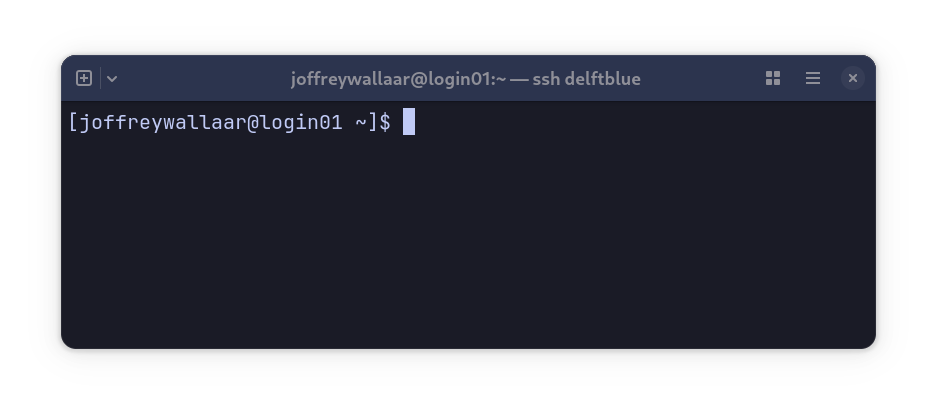
The command prompt is the part of the part of the screen where you can type, the part that ‘prompts’ you to issue a command. It can be fully customized via the PS1 environment variable, but most Linux distributions follow the same general layout:
user @ hostname : location in filesystem $ cursor
Your first command
“Present Working Directory”
This command shows your current location in the filesystem.
Filesystem shortcuts
| Shortcut | Description |
|---|---|
~ or $HOME |
Your home directory |
/ |
The root directory |
. |
The current directory |
.. |
One directory up |
Options
The ls command, but with an option to make it behave differently.
ls -lOptions can be combined and often written in full.
ls --all --recursiveHow does --all change the behaviour of ls?
Whenever you write a bash script, it is recommended to use fully written out version. This makes your scripts a lot more readable. However, this version is not always available. Famously,
ls -ldoes not have a fully written out option. This option is so common that many famous Linux distributions like Ubuntu and Red Hat, which is installed on the DelftBlue supercomputer, ship with an alias ll. An alias is like a shorthand command that you can specifiy yourself. The ll alias maps to ls -l.
Aliases are generally set in a file called ~/.bashrc using the syntax:
alias ll="ls -l"Arguments
You can also pass an argument to a command.
This shows the contents of the Documents folder:
ls ~/DocumentsYou’ve been using arguments before:
cd DocumentsGetting help
Almost all commands have a help option that will show you the proper syntax and the most common options:
ls --helpfor more in-depth information you can also consult the manual:
man lsWhat would you call the ls part of this command?
ls -a -S -r -l /home/cli101/Documentsls -all --sort=size --reverse -l $HOME/Documentsls -aSrl ~/DocumentsThese commands are identical in function.
- The first one is not very useful; it is concise nor easy to type.
- The second one is the type of syntax that is recommended to use in your scripts. Because of the fully written out options and the use of the environment variable
$HOMEit is easy to parse, and portable between systems. - The last one is the most concise, so you would use this while working on the command line interactively.
Exploring file contents
cat |
Simply ‘print’ file contents to the terminal. Good for use in scripts, or small files. |
less |
More options including search. man uses less to display the command manuals. |
cat filename
less filename
File operations
Copy:
cp source_file targetMove or rename:
mv source_file targetCreate a directory:
mkdir directory_nameDeleting files:
rm file_nameWhen dealing with file operations, dealing with the meta information is much more expensive than dealing with actual data. For your personal system, which has a blazing fast harddrive, that is only for you, this does not present any problems.
However, when you ‘upgrade’ to a supercomputer like DelftBlue, the storage is connected via the network, the storage is shared with 1500 other users, and the filesystem is optimized to deal with very large files. Not so much with a lot of small files. So, if you have lots of small files, you absolutely should package your data in a large zip file or a pickle to prevent your program bringing the file system to its knees.
Deleting directories
To delete a directory you simply add the --recursive option, or -r / -R
rm --recursive directory_nameTo avoid being asked if you want to delete every single file, you can add --force, or -f.
rm -rf directory_nameI’d like to bring to your attention that in the command line there is no Trash. I have personally lost quite a bit of work by not having a proper backup and mindlessly issueing a rm -rf. This is why I always teach my students that -rf is short for RED FLAG. Please try to internalize this to prevent a disaster.
(Or just have a proper backup strategy…)
Editing files
vim, or v(i)mproved is a powerful code editor that lives in your terminal. We teach the basics of using this editor because it is a staple in every Linux distribution. So, even if some courses choose to teach editors that are a bit easier in use, the problem is that you cannot be certain that these will be available on every supercomputer you might want to log in to. The older brother of vim, vi (from 1976), will always be available. Thus, having some very basic knowledge of how to operate vi is an essential skill in High-Performance Computing.
Vim commands
from normal mode
:w |
Save / (W)rite to disk |
:q |
Quit |
:wq |
Write and quit |
:q! |
Force quit, without saving |
i |
Go to insert mode |
u |
Undo |
Esc |
Go to normal mode |
/ |
Search |
:set number |
display line numbers |
Personal note
The vim motions, as the dual mode system of code manipulation is called, has been around for decades. Some consider it to be the best way to interact with code. Period. While learning Vim to the extent that you’d use it as your daily driver is definitely beyond the scope of this course, I will tell you I have never met a single coder who put in the effort of learning the motions and regrets spending that huge amount of time. Maybe this is an example of the sunk cost fallacy though, I don’t know.:wq
Redirecting output
Redirect output to a file:
./fixme.py > output.txtAppending output to a file:
./fixme.py >> output.txtRedirecting output to the stdin of another command.
./fixme.py | lessInstalling packages in your $HOME
For this example, we will use a language specific package manager many of you will be somewhat familiar with. Python’s pip will notice you are not a sysadmin and will default to installing packages in the .local folder in your $HOME.
Proceed with installing the ase Python package, as we will need this in the next section.
pip install aseYou might encounter an error message stating you cannot install this package because the system is externally managed. You can circumvent this by issueing the ominous command
pip install ase --break-system-packagesI promise you will not break anything. This is just your distribution of Linux warning you that you’re mixing packages from their repositories with the ones that pip uses, which are generally newer. This is why, for production projects, it is recommended to create a virtual environment that holds all the dependencies for that project. This way you can be sure that nothing breaks because some versions of dependencies do not line up. You can create a virtual environment with the Python package venv, conda or with the much more modern uv package manager.
Permissions
File permissions allow you to control who has what kind of access to your files. To control thos you have to set mode bits.
In a nutshell, there are three levels of ownership:
- user
- group
- other
Remember u, g and o. There are also three types of permissions:
- read
- write
- execute
Remember r, w, and x.
This is what a typical output of ls -l looks like. By now you’re probably quite familiar with it.
-rwxr--r-- 1 cli101000 student  150 May  6  2022 bash_script.sh*
-rw-r--r-- 1 cli101000 student 5079 Nov 30  2022 gen_mol_folders.py
dr-xr-xr-x 2 cli101000 student 4096 Nov 30  2022 molecules/
-rw-r--r-- 1 cli101000 student 2028 May  6  2022 plot.jl
-rw-r--r-- 1 cli101000 student   58 Mar 16  2022 regular_textfile.txt
lrwxrwxrwx 1 cli101000 student   22 Mar 16  2022 softlink_to_home -> /home/cli101/cli101000/
--w-r--r-- 1 cli101000 student 1550 May  6  2022 table.txt
drwxr-xr-x 2 cli101000 student 4096 Mar 16  2022 this_is_a_directory/
Notice every line starts with a lot of cryptic r, w, x characters? These represent the mode bits. The very first column indicates if the listing is a file(-), link(l) or directory(d). Then, the mode bits start. Three tuples of rwx. One for the owner of the file, one for the group, and one for everybody else. A - means that the permission is not granted.
Set mode bits
Remember u, g, o (and a for all) and r, w, x. The command to change the mode bits is called change mode or chmod.
chmod u+x filenamechmod go-wx filenamechmod a+rwx filenameDo you think the last one is smart on a multi-user computer like DelftBlue?
Remote access
Ever since computer networks exist there have been programs around that allowed you to interact with remote systems. One of those programs was called rsh, short for remote shell. The problem with the network traffic from rsh is that it is not encrypted. This means that anyone with access to the network can potentially sniff your network packets, and might be able to gain unauthorized access to the system.
Enter ssh, or secure shell. The traffic is encrypted and many more safety measures were implemented. This is the program that everyone should use to connect to remote systems.
Connect to DelftBlue
Try to log in to DelftBlue using your netid:
ssh -l <netid> login.delftblue.tudelft.nlFeels inefficient? Fortunately there is a shorthand:
ssh <netid>@login.delftblue.tudelft.nlConfigure ssh
When using ssh for the first time, a new folder is created in your $HOME: .ssh. Inside this folder we can use vim to create a file named config:
Host delftblue
    HostName login.delftblue.tudelft.nl
    User <netid>
With this file in place you can connect to DelftBlue much easier:
ssh delftblueThis now works for all programs that use ssh under the hood.
Transfering files
To transfer files to a remote system we use secure copy
scp sources hostname:target_directoryscp is the successor to rcp, short for remote copy. Built upon the ssh stack, scp uses the same authentication and security. This means we have already configured the program for use with delftblue!
Other than that, the syntax is similar to cp. Many of the options are the same, like -r for recursive copy is you want to copy folders. The syntax for targeting files and folders on a remote host is this: username@hostname:/path/to/file. Note that you cannot use $HOME here because this will evaluate on your local machine. ~ works just fine though.